Last Updated on August 7, 2026
Evidence-based content
All content on ThyForLife is developed from peer-reviewed scientific literature, published clinical guidelines, and data from accredited medical research institutions.

A quick anatomy lesson that can make your at-home neck checks far more accurate.
If you’ve ever run a finger down the front of your neck looking for your thyroid, there’s a good chance you found the wrong bump. The prominent ridge most people call the Adam’s apple isn’t your thyroid gland at all. It’s a completely different structure called the thyroid cartilage. The two share a name, sit in roughly the same neighborhood of the neck, and are constantly mixed up. But knowing the difference isn’t just trivia. It’s important because it’s the key to doing a neck self-check correctly, and to understanding what your doctor is actually feeling for during a thyroid exam. Here’s how to keep them straight.
What the thyroid cartilage actually is
The thyroid cartilage is a shield-shaped piece of cartilage (not a gland) that forms part of the skeleton of the larynx, or voice box. Its job is purely structural. It protects and supports your vocal cords. The name comes from the Greek word thyreos, meaning “oblong shield,” which is exactly what the ancient Roman and Greek physician Galen thought it resembled when he first described it. In most people, especially men, its two halves meet at a sharper angle in front, creating the visible bump we know as the Adam’s apple. It grows more prominent during puberty under the influence of testosterone, which is why it tends to be more noticeable in men. Structurally, it has nothing to do with hormones, metabolism, or the endocrine system.
So where is the real thyroid gland?
Your actual thyroid, the butterfly-shaped endocrine gland that produces T4 and T3 and helps regulate your metabolism, heart rate, and body temperature, sits lower and slightly deeper in the neck than the Adam’s apple. Between the two is another, less famous piece of cartilage: the cricoid cartilage, a firm ring that sits directly below the thyroid cartilage. The thyroid gland’s connecting bridge, called the isthmus, lies just beneath the cricoid cartilage, draping across the windpipe, with the gland’s two lobes curving back around either side of it. In practice, that means the thyroid gland sits closer to your collarbones than to your chin. This is well below the bump most people would typically point to when asked to “show me your thyroid.”
Why do they share a name?
The reason for this is actually simple. In the 1600s, English anatomist Thomas Wharton named the gland “thyroid” simply because of its proximity to the thyroid cartilage. It was certainly not because the two structures do the same job. He borrowed a term Galen had already used for the cartilage over a thousand years earlier.
Why the distinction actually matters
As mentioned earlier in this article, getting the location right changes how useful a home neck check actually is. Health organizations that promote self-exams for early detection of thyroid nodules and goiter are explicit on this point: don’t confuse the Adam’s apple with the thyroid gland. If you’re only examining the area around your Adam’s apple, you may be looking in the wrong place entirely and missing a swelling or nodule that’s sitting an inch or two lower, closer to your collarbones.
How to do a neck check in the right spot
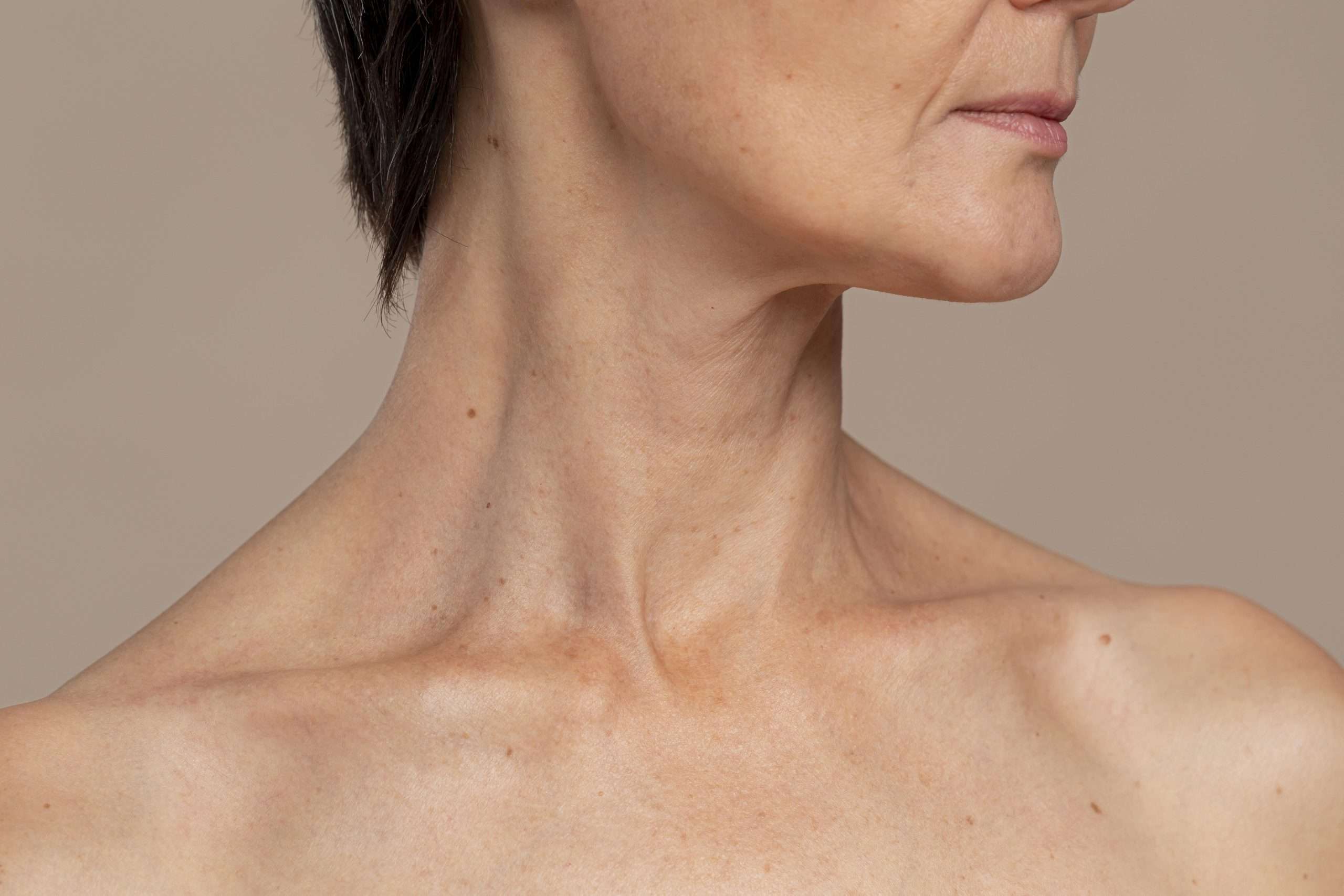
- Stand in front of a mirror and locate the lower front of your neck. The area above your collarbones and below your Adam’s apple, not the Adam’s apple itself.
- Tilt your head back slightly to bring that area into better view.
- Take a sip of water and swallow while watching that lower area closely.
- Watch for any bulge, swelling, or asymmetry that moves upward as you swallow. The thyroid gland moves with the larynx during swallowing, so a true thyroid lump will shift too.
- Repeat a couple of times, and if you notice anything unusual, bring it to a doctor’s attention rather than trying to self-diagnose.
A home check is a helpful habit, but it’s a screening tool, not a diagnosis . Many nodules and even some cases of hypo- or hyperthyroidism produce no visible or palpable changes at all. Blood tests remain the most reliable way to know how your thyroid is actually functioning.
Key takeaways
- The thyroid cartilage (Adam’s apple) is a shield-shaped piece of cartilage that protects the vocal cords. It has no hormonal function.
- The thyroid gland is the actual hormone-producing organ, located lower in the neck, just below the cricoid cartilage, closer to the collarbones.
- Both structures share the root word “thyroid” (Greek for “shield”) simply because the gland was named after its cartilage neighbor in the 1600s.
- When doing a neck self-check, focus on the lower neck, not the Adam’s apple, and watch for movement during swallowing.
- A visible or palpable change is worth a doctor’s evaluation, but a normal-looking neck doesn’t rule out a thyroid function problem, since those are usually only caught with bloodwork.